
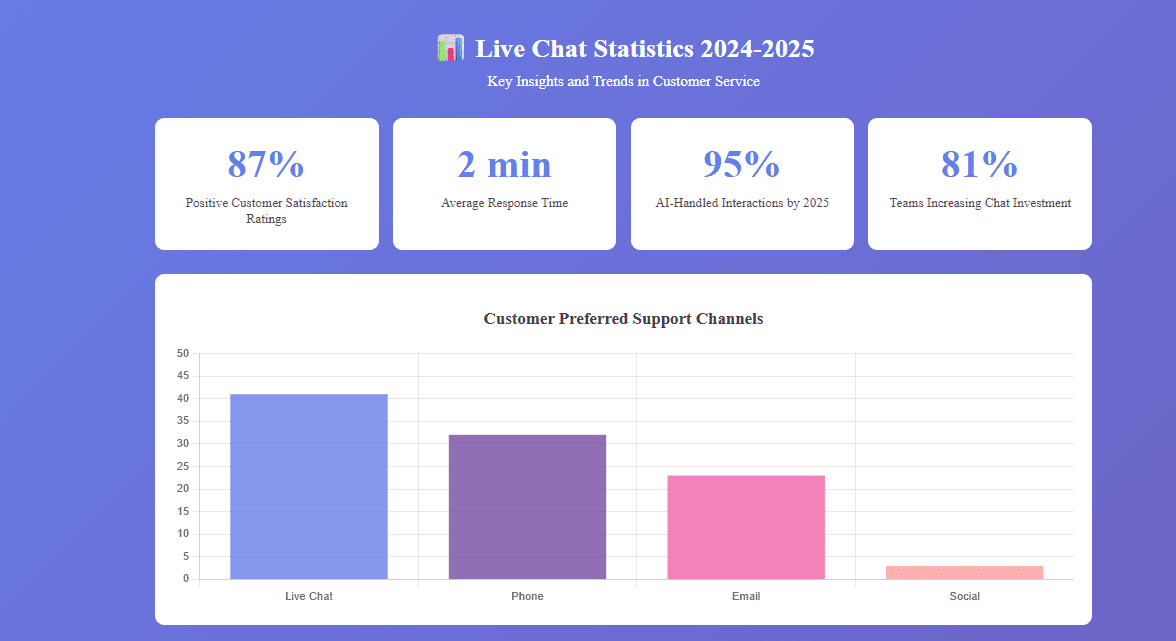
In 2024, live chat has become one of the most preferred customer service channels, with 87% of chats receiving positive customer satisfaction ratings. Customer service live chat combines real-time conversation with the ability to share links, collect information, and save a full transcript for later reference. It’s the ideal online service tool for a customer who needs immediate help.
Getting started with live chat is simple, but making it a sustainable, effective part of your customer service strategy takes careful thought and effort.
WHAT IS LIVE CHAT?
Live chat is a support channel that gives customers and support agents a way to have real-time, back-and-forth, text-based conversations. Customers can send questions to a person who can answer them quickly in a small window using live chat software embedded on a company website.
According to recent data, the average response time for live chat is just two minutes, significantly better than other channels like social media (10 hours) or email (12 hours).
BENEFITS OF LIVE CHAT
Uninterrupted 24/7 Support for Customers
In 2025, 81% of customer service teams plan to increase investment in chat platforms. One of the major benefits of live chat for customer service is how it allows companies to offer always-on assistance to users whenever they need it. Customers can engage in real-time conversations with your business at any time, day or night, giving them access to practical solutions in a maximally convenient fashion.
While most people probably still associate the concept of live chat with human agents, it now encompasses much more than that. By 2025, artificial intelligence is predicted to handle 95% of all customer interactions. Even if agents can’t be on duty around the clock, live chat makes it possible to assist customers at any time through automation and AI.
For example, an automated chatbot can direct users to self-service support options in your knowledge base. Meanwhile, an AI chatbot can automate up to 70% of customer inquiries through comprehensive automation, utilize your help center to source reliable information, compose answers to queries, and forward more complex questions to support reps during business hours.
Proactive Customer Assistance
This live chat benefit goes beyond its conventional role – that is, to enable customers to talk directly with a support rep. The best tools in the market also allow live chat messengers to enable proactive assistance. With this feature, you can engage customers in proactive support through targeted outbound messages, paving the way for long-term satisfaction and success.
Rather than waiting around for customers to ask questions during onboarding, you can actively push contextual task lists to them in the live chat itself. This ensures they have everything they need to smoothly navigate products or services – including more challenging ones with steeper learning curves – on their own schedule.
Proactively walking users through common processes like setup and implementation means customers spend less time searching and more time doing. They’ll appreciate the personalized guidance that clears roadblocks so they can stay focused on core tasks.
Support Across All Channels
Live chat may seem like a standalone channel, but it can seamlessly integrate with other existing solutions, offering support across multiple channels. About 60% of customers say they are more likely to return to a website that offers live chat, and over 63% are more likely to purchase from sites with live chat widgets. All of your customers will experience a more seamless support journey as a result of this integration.
Beyond your app or website, a robust live chat solution goes beyond that. It’s also capable of integrating with your other tools and channels, allowing you to meet customers where they are and provide exceptional support that consistently goes the extra mile.
You can, for instance, make it even easier for customers to contact your business by integrating with WhatsApp, one of the most widely used communication platforms worldwide. Conversation history is carried across channels with omnichannel integration. This empowers your team to deliver personalized and efficient support without losing context. No matter which channel customers choose to engage with, your team is equipped with the necessary information to provide a seamless and highly tailored experience.
Efficient Resource Management
In challenging economic times, efficient resource management proves even more critical for support success. In 2024, 43% of companies are investing in AI, chatbots, and automation to improve speed and scalability in support. With budget cuts and headcount reductions, there’s a great deal of pressure on customer service teams to achieve just as much, if not more, with limited resources.
The key lies in finding the right live chat support tool – one that strikes a perfect harmony between human and automated assistance. Companies using AI for marketing report a 37% reduction in costs and a 39% increase in revenue. This allows your personnel to dedicate more of their bandwidth to circumstances and scenarios where they elevate customer experiences the most: the more complex and challenging conversations that require a human touch, such as tackling intricate technical issues.
By implementing simple yet effective live chat best practices, you can optimize your support resources, saving your company time, money, and energy – incredibly valuable resources in all service departments – all while delivering excellent customer service.
LIVE CHAT TIPS FOR CUSTOMER SUPPORT AGENTS
According to recent studies, 73% of customers feel more comfortable communicating with customer service via live chat than email (61%) or traditional phone support (44%). Delivering high-quality live chat support requires, as Liam Neeson might say, “a very particular set of skills.” With these live chat tips, you can build on your email support expertise.
Manage the Conversation
Email support is like old-school letter writing with really fast mail carriers, but chat support works more like a live conversation. People can talk over each other, or one person can really dominate the discussion. Customer satisfaction peaks at 84.7% when initial response time falls within the 5 to 10-second range. So guiding a live chat to a successful end means keeping control of the conversation.
Keep live chat running smoothly by following these guidelines:
Get everyone on the same page. Make sure that you and your customers are clear about what they need and what you need from them.
Set accurate expectations. In a recent report, an average of 4 minutes and 18 seconds is the average wait time before a customer reaches an agent. If you’re going to need to step away from the chat, tell customers what’s happening so they don’t freak out and think you’ve disappeared.
Set clear boundaries. Don’t be afraid to ask customers to focus on one thing at a time so that you can best help them. And be sure to have some prepared responses for cases of abuse or inappropriate behaviors.
Know when to transfer channels. Some questions are just best handled by email or on the phone, so think about what those might be for your team. And when they come up, make that transition as graceful as you can.
Write Concisely
In chat, conversations can scroll past quickly, and they’re often squeezed into a pretty small frame surrounded by all sorts of distracting things. So it’s vital that you get to the point quickly and clearly if you want to be understood.
To get better at writing concisely, follow these tips:
Build up your knowledge. It’s when you try to teach something that you discover if you really understand it. You need to know what information is the most important to get across and what could be safely left out.
Ruthlessly cut the fluff. Inconsistent explanations and uncommon edge cases can hinder comprehension. Quickly get to the essential response.
Always speak in plain English. Avoid using internal jargon or quirky marketing terms. Stick to the words that your customers use, and be sensitive to their different cultures and different language backgrounds.
Be specific in your directions. Instead of saying “jump over to the user preferences area,” say, “click account, then click billing.” That precise word choice is going to avoid a whole lot of customer confusion.
Take Time to Teach
Sometimes, your customer just needs your help to take an action that they can’t take. According to an Intercom study that included responses from 2,000 professionals, 40% of support teams say live chat software is one of their most-used tools. But other times you’ve got an opportunity to help them understand your service or your product more deeply — or to teach them how to solve their own problem.
In these cases, you should:
Promote your self-service help documents. Let them know where they are and how they can search them and find them.
Encourage exploration. Point them to product features or items that they may not have seen yet.
Share setups or tips that are unique to their use. You want to help your customers kick butt instead of having to drag a butt over for you to kick it for them.
A support team may find it challenging to add a whole new channel, but you are opening up real-time communication with your customers. That is a fantastic chance to improve their experience and have conversations that are less likely to take place via email.
Live chat has evolved from an optional feature to a vital element of modern customer service strategy. With the rise of consumer expectations for immediate responses, personalized communication, and 24/7 support, businesses that embrace live chat technology and integrate it with AI and automation are positioning themselves for long-term success.
The statistics clearly show that live chat not only improves customer satisfaction and reduces operational costs but also creates opportunities for deeper customer engagement and business growth. As technology continues to advance, businesses that invest in sophisticated live chat solutions will be better equipped to meet the evolving demands of their customers and remain competitive in the digital marketplace.
Whether using tools like Help Scout’s Beacon or other platforms, the key to success lies in balancing automation with the human touch, ensuring proactive support, and creating a seamless, omnichannel experience that values customers’ time and needs.


